Research Library

Golden Gate Transit >  Research Library >  Transit History Printer friendly version of this page

Transit History


Birth of the Golden Gate Bus and Ferry Transit System

Just over 3.3 million vehicles crossed the Golden Gate Bridge during the first full year of operation.  By 1967, annual crossings had grown over 750 percent to 28.3 million vehicles.  Between 1937 and 1967, traffic grew at an annual average rate of 70 percent.  The Bridge was close to reaching the saturation point and the public needed an alternative to the private automobile.

As the congestion mounted, several studies were undertaken to identify alternate means of travel between Marin County and San Francisco.  The "San Francisco-Marin Crossings" report of May 1967 looked at the possibility of building another bridge.  The Marin County Transit District considered taking over the existing Greyhound system as a commute service to San Francisco.  Greyhound provided transit between Marin and San Francisco at the time and it was so unprofitable, management wanted to abandon it.  The District also considered adding a second deck to the Golden Gate Bridge.

Photo: Golden Gate Transit Bus    
Photo copyright ©  Golden Gate Bridge,
Highway and Transportation District.
All Rights Reserved.

While these studies proceeded, the District was able to provide some relief to the traffic problem.  In 1963, reversible lanes were inaugurated on the Bridge, greatly aiding the flow of traffic during the heavy peak periods.  In 1968, the Golden Gate Bridge was the first in the world to offer one-way toll collection.  The system proved so successful it has been instituted on many bridges throughout the world.  Still, the traffic kept growing.

Driven by the post-World War II building boom in Marin and Sonoma counties, by the mid-1960s thousands of commuters were traveling by automobile across the Golden Gate Bridge to San Francisco.   As air pollution increased and congestion took its toll on commuters traveling across the Golden Gate Bridge, San Francisco, Marin and Sonoma counties asked the District to implement a bus transit plan developed by Marin County Transit District.  The plan called for bus service from neighborhoods in Marin and Sonoma counties to the San Francisco Financial District and Civic Center areas.

By the late 1960s, the Golden Gate Bridge was operating at capacity during the morning commute.  Original Bridge construction bonds had almost been retired and the District had approximately $22.8 million in reserves.  On November 10, 1969, the California State Legislature passed Assembly Bill 584 authorizing the District to develop a transportation facility plan for implementing a mass transportation program in the Golden Gate Corridor.  This was to include any and all forms of transit, including ferry.  At that time, the word "Transportation" was added to the District name to indicate its new commitment to public transportation.

The mandate from the legislature was clear:  Reduce traffic congestion on the Golden Gate Bridge and in the 101 Corridor.  The legislature did not give the District the authority to levy taxes, nor could Bridge tolls support local intracounty transit services.  Only intercounty service could be subsidized by Bridge tolls.

  Photo: Golden Gate Transit Bus at Transit Center
Photo copyright ©  Golden Gate Bridge,
Highway and Transportation District.
All Rights Reserved.

On December 10, 1971, Assembly Bill 919 was passed requiring the District to develop a long range transportation program for the corridor.  After an extensive public participation program, including 21 public hearings in six counties, a unified system of buses and ferries emerged as the best means to serve the people of Marin and Sonoma counties.  The bus system is commonly known today as Golden Gate Transit (GGT) and the ferry system is known as Golden Gate Ferry.

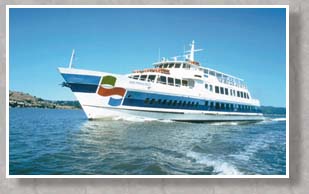
On August 15, 1970, the District took its first step into the transit business by inaugurating ferry service from Sausalito, California, in southern Marin County to San Francisco.  In December 1970, the first shuttle bus service began serving the Sausalito Ferry landing using five leased Greyhound coaches and four drivers.

In September 1971, the first 20 of 132 newly purchased buses were received by GGT at the original yard on Jacoby Street in San Rafael. Additionally, 30 experienced Greyhound drivers were hired.

In December 1971, local Marin County bus service began under contract to Marin County Transit District (MCTD), now known as Marin Transit.

On January 1, 1972, intercounty bus service from Sonoma and Marin counties to San Francisco began with 152 buses (20 additional buses were leased) and facilities in Novato and Santa Rosa, and a temporary facility in San Rafael.

In 1976, a new ferry service was initiated between Larkspur, in central Marin County, and San Francisco with delivery of three 25-knot (28 and 3/4 MPH) high capacity vessels.  The capital cost of the bus and ferry system was financed by a combination of federal grants from the Urban Mass Transportation Administration (now the Federal Transit Administration) and District reserves.

   Photo: Bridge Opens to Traffic on Day 1
Photo copyright ©  Golden Gate Bridge,
Highway and Transportation District.
All Rights Reserved.

In 1990, GGT initiated intercounty commute bus service from Sonoma County to Marin County employment centers. In 1992, the C. Paul Bettini Transit Center in San Rafael opened and is GGT’s busiest transit station and transfer point. In 1993, GGT, acting on behalf of the Metropolitan Transportation Commission (MTC), began operation of regional bus service between Marin and Contra Costa counties via the Richmond-San Rafael Bridge. In 1993, GGT initiated Americans with Disabilities Act (ADA) intercounty complementary paratransit service through an agreement with Marin County and its paratransit contractor. In 1999, GGT installed bicycle racks on all buses that are shorter than 45 feet. In 2006, GGT installed bicycle racks in luggage compartment on buses that area longer than 45 feet.

Since the birth of Golden Gate Transit, the bus and ferry system has become an integral part of life in the North Bay.  Our services have adapted to the changing needs of growing communities, and also responded to the needs of individual patrons.  Through its growth, Golden Gate Transit has continued to fulfill the mission of reducing automobile traffic and congestion while contributing to the protection of the environment with efficient, reliable and cost-effective alternatives to the private automobile.   As a result, traffic growth in the Golden Gate Corridor has been held to a manageable level. 

By October 16, 2006, all 45-foot long MCI buses were equipped with bike racks in the “underbelly” luggage bays that can accommodate two bicycles. Grant funding for the racks was provided 20% through the Transportation Fund for Clean-Air (through Transportation Authority of Marin) and 80% through Federal Transit Administration.